Jojo No Kimyou Na Bouken Snes Game Box Art
JoJo's Bizarre Adventure (ジョジョの奇妙な冒険 , JoJo no Kimyō na Bōken) is the name commonly given to whatsoever 1 of the versions and ports of a fighting game adult past Capcom Westward , based on the tertiary function of JoJo's Bizarre Run a risk, Stardust Crusaders.
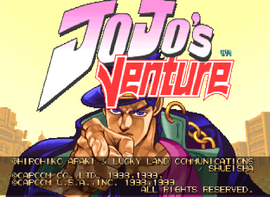
It was originally released every bit an arcade Due west game on December 2, 1998 on the CPS-3 W board organization; this version was known outside Japan equally JoJo's Venture . An updated version of the game was released on September 13, 1999, every bit JoJo's Bizarre Chance: Heritage for the Future (ジョジョの奇妙な冒険 未来への遺産 , JoJo no Kimyō na Bōken Mirai e no Isan), condign the sixth and last game released for the CPS-three W . Console ports of this version for the PlayStation W and Dreamcast W were released later that year, while a high-definition version titled JoJo's Bizarre Adventure Hard disk drive Ver. was released for PlayStation Network and Xbox Alive Arcade in August 2012.
Contents
- one Contour
- ii Gameplay
- ii.1 Stand Mode
- ii.2 Ambivalent
- ii.3 Blazing Fists Match
- 2.4 Bonus Stages and Special Battles
- two.5 Clandestine Factors
- 3 Characters
- 4 JoJo's Bizarre Adventure: Heritage for the Future
- iv.ane Differences between JoJo's Venture and Heritage for the Future
- 4.2 PlayStation Version
- 4.2.one Super Story Mode
- 4.3 Dreamcast Version
- four.three.1 Alessi Mode
- 4.four New Characters
- 5 JoJo's Bizarre Adventure HD Ver.
- 5.1 Features
- 5.ane.1 Story Mode
- 5.1.two Online Play
- 5.2 Achievements
- 5.1 Features
- half dozen Differences from the manga and anime
- 7 Proper noun Changes
- eight Gallery
- eight.ane Artwork
- viii.2 Sprites
- 8.3 Stages
- 8.four Hard disk drive screens
- 9 Videos
- 10 Trivia
- eleven Site Navigation
Profile
The games were adult by the same team responsible for the Street Fighter III serial. The game combines Capcom'south trademark anime-inspired graphics, as seen in the Darkstalkers W series, with the colorful characters and events of Hirohiko Araki's creation, resulting in a highly stylized and detailed visual way. It also features many of the gameplay mechanics seen on previous Capcom fighting games, such as the use of power gauges for super moves, as well as a brand new Stand up Mode, where a character's Stand tin can be summoned or dismissed at will by the player, resulting in variations on the character's move listing and abilities.
Hirohiko Araki served equally a consultant for the game and created sectional pieces of artwork for its promotion and packaging; most notably, he developed from scratch a new character design for Midler, since Capcom was interested in using her in the game and she had been only vaguely shown in the original manga. Araki patterned near of Midler's revised design from Yukako Yamagishi from Diamond is Unbreakable, having similar body builds.
The game prominently features illustrations straight from the manga, some with unique touches just for the game. Almost notable in the game is the confront-shot of a defeated enemy if finished off with a super combo move, whose animation also reflect the kind of damage received; the portrait would exist riddled with bullet holes, bisected or bloodied, depending on the finishing motility.
Later revisions of the games include shoutouts to other parts of the series.
This game and its revisions were among the showtime pieces of JoJo-related media released in N America, exposing the series and its characters to many western players and audiences for the first time.
Gameplay
The bones gameplay mechanics are those of a standard fighting game: 1-on-one battles consisting of two or three time-express rounds, in which the goal is to deplete the adversary's health bar using both regular attacks besides equally grapheme-specific special and super moves, which crave the input of push button combinations and/or spending accumulated free energy, outputted in a power judge which fills with every time harm is dealt or taken.
The game uses a simplified 4-button control scheme, consisting of three attacks (light, medium, and heavy) and a Stand up button, which switches the character'southward Stand On and Off (run across Stand Style below)
Stand Manner
Fighting with the Stand up Style "On" enhances both the character'south offensive and defensive abilities; these improvements heavily depend on the graphic symbol and Stand up, but some mutual ones are for example double jumping, absorbing residual damage when blocking special attacks, powered-upwards special moves, etc.
Nigh of the game's specific mechanics derive from the introduced Stand Mode. For case, attacking the concrete manifestation of the opponent's Stand will mirror the effects to its wielder; this is a crucial strategic element, since many of the special moves and attacks send the Stand away from the User, calculation the difficulty of protecting both of them at the aforementioned fourth dimension; if a primary character is damaged while their Stand is far away, the harm received is doubled. On peak of the usual health bar and power guess, there is a third meter, the Stand Gauge, which decreases when the Stand is damaged and refills when the Stand Way is switched off; if this gauge is depleted, a Stand up Crash takes outcome, and the character is paralyzed and broad open to any assail for an instant.
Other features of the Stand up Manner include summoning the Stand with an instant attack, the possibility of "programming" assail patterns on the fly and unleashing them at volition, "releasing" the Stand and controlling information technology direct, and then along.
Some characters lack an "active" Stand, though; some of these "passive" Stand up Users introduce fifty-fifty more complex and specific mechanics into the game, such as Hol Horse'due south Emperor, a gun Stand, or Mariah's magnetic Stand Bastet.
The functions of each Stand create stiff differences between the characters, and force often radically dissimilar offensive approaches for each one; this "character-dependent gameplay" mode would be afterwards present in posterior fighting games, such as the latter entries of the Guilty Gear serial, which, interestingly plenty, also contains Stone and pop music references.
Clashing
If certain attacks of the same strength and same intensity occur and collide at the same time, clashing occurs. This only happens with characters with an Active Stand up. It is hard to see this organisation in activity as it happens very seldom. This mechanic would later be incorporated into time to come JoJo games, such every bit All Star Battle In some cases, ambivalent can lead to a Blazing Fists Match. (see below)
Blazing Fists Match
One of the lesser-known features of the game, just also i of the more than impressive, is a Blazing Fists Lucifer, caused when two certain opposing special moves performed by certain characters at the very same time collide; the player/southward are and then prompted to rapidly tap the attack buttons to win the duel and decide who volition receive impairment, a characteristic first seen in Samurai Shodown. This feature has since been adopted and expanded in All Star Battle.
Bonus Stages and Special Battles
Across the game, and if sure conditions are met, the player volition take to articulate special stages and face secret opponents. In these battles, special rules are applied in order to reenact certain chapters of the original manga that were less "translatable" under the normal circumstances of the 1v1 battles.
Such characters include:
- Impostor Captain Tennille, Nena, ZZ , Oingo, Boingo, and Telence T. D'Arby, which are not fought directly. Instead, their respective battle is narrated somewhat shut to the manga, with the occasional quick-time-consequence appearing every bit the sprite of an incoming hazard or assault appears on the screen. Said QTE involves choosing the right direction out of four, which is ever the highlighted arrow.
- Forever is fought in Jotaro'due south signal of view. Instead of a archetype fight, the game turns into a shooter. The screen is static and Forever can appear from several places, sending objects at the screen/at Jotaro. The thespian must shoot Forever and his projectiles (represented as Star Platinum punching) to deplete Forever's wellness bar. Forever can occasionally take the runaway daughter hostage, forbidding Jotaro from punching the ape.
- Arabia Fats and Kenny G are fought through a like type of minigame. Instead of fighting them the actor must find the hidden enemy in the groundwork, helped by pocket-sized hints on a secondary screen (a reflection in Arabia Fats' case and the actual position of Kenny One thousand in his example although the complex background compensates). The player must discover them four times before the timer expires.
- Daniel J. D'Arby is fought through three unique minigames reflecting how the Joestar Group gambled against him in the manga. Starting time is a betting game in which Polnareff must choice a piece of fish out of two choices. Second is a minigame in which Joseph and D'Arby must put coins in a glass of water. They tin choose how many coins they put in the glass, merely the actor must printing a button at the right moment, represented as ii cursors panning across a bar at dissimilar speeds to have matching positions. The more coins one puts, the more difficult the timing is. Finally, Jotaro challenges D'Arby to a poker minigame.
- Due north'Doul is not fought conventionally. Instead, Jotaro finds himself on a corridor level and must achieve N'Doul at the end of the level while avoiding Geb's attacks by jumping or dashing. His character portraits tin nonetheless be constitute in the game, and he was originally intended to be playable.
- Vanilla Ice and Mannish Male child (or rather Death Xiii) can exist fought in a 1v1 fight using the main gameplay, but are not playable otherwise.
Secret Factors
The Super Story mode has a last minor gameplay feature known as "cloak-and-dagger factors". Every bit nods to the story of Stardust Crusaders, playing out the scenario akin to official canon volition activate these factors. If the player activates the scenario correctly, information technology gives them a high ranking upon winning the scenario. This is a unique feature that as well celebrates its source material and rewards fans and readers of the serial.
This feature later appeared in GioGio'due south Baroque Adventure another game based on the JoJo's Bizarre Adventure license and a Capcom Westward product.
Characters
| Characters from JoJo'due south Venture | ||||
|---|---|---|---|---|
| | | | | |
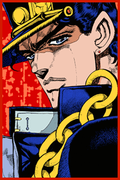
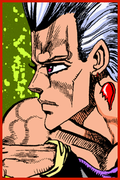
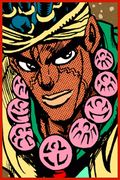
| Jotaro Kujo | Joseph Joestar | J.P. Polnareff | Noriaki Kakyoin | Muhammad Avdol |
| | | | | |
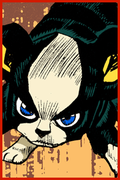
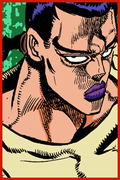
| Iggy | Devo | Chaka | Midler | Alessi |
| | | | ||
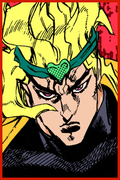
| DIO | Proud Lineage Joseph | Shadow DIO | ||






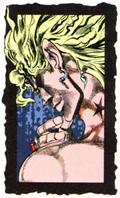
JoJo's Bizarre Adventure: Heritage for the Time to come
JoJo'southward Bizarre Run a risk: Heritage for the Future (ジョジョの奇妙な冒険 未来への遺産 , JoJo no Kimyō na Bōken Mirai due east no Isan) is an updated version of the game, released on September thirteen, 1999, on the CPS-three W arcade system. This version featured eight additional playable characters and adjustments to the game for balancing purposes.
Differences between JoJo'due south Venture and Heritage for the Future
- The Guard Abolish motion was changed, at present having similarity to the Darkstalkers series.
- New moves for several of the returning characters. (Notably Jotaro, who gains new variations for his Blazing Strike, among others)
- A modest change to Jotaro'due south Puttsun Ora, now performable in the air.
- DIO is at present selectable from the showtime and does not crave the unlocking codes equally seen in JoJo's Venture. (He tin can exist unlocked through the character select screen or permanently via the service card previously)
- All hidden characters are time-released (arcade), alternatively unlockable through the arcade game's service carte du jour, or requires finishing the game with certain characters (console).
- Vanilla Ice becomes a playable grapheme, vastly dissimilar from his NPC mini-dominate version.
- In HFTF, Vanilla Water ice's dominate AI is more or less manageable and possibly toned downward across all difficulties. In JoJo'south Venture, his AI is notoriously difficult specially without the cognition of dodging and other of the game's mechanics.
- A major variation of Polnareff is available (Anubis Polnareff).
- Three brand new characters are selectable (Pet Shop, Mariah, and Hol Horse).
- There are four boosted subconscious characters (Rubber Soul, Khan, Fearless Kakyoin, and Hol Equus caballus w/ Boingo).
- The overall motif, including opening and endmost credits as well equally the character select theme, are dissimilar.
- The "Survival" option has been replaced by a 10-battle "Challenge Mode".
- Cosmetic changes for all characters, including more color variations per button, including the Start button.
- Equally with the change of motif, the Super Combo character cutscreen is now different and dynamic in nature, as is the Super Combo chime. The Tandem Attack cutscreen is different as well, now resembling zooming starfield over yellow groundwork, reminiscent of the Street Fighter Alpha series.
- Some actress sound effects take been added and changed, including the aforementioned Super Combo chime, and the 1000.O. sound effect, new to HFTF.
- Of special note is that the Super Combo chime would be reverted to JoJo's Venture in the game's Dreamcast port, and the Hard disk Version.
- During cutscreens betwixt rounds, the power stock carries over in JoJo's Venture. However, they reset dorsum to Level 1 in HFTF, as a possible rebalancing or programming oversight.
- In the game'due south files y'all tin discover a scrapped version of what seemed to be a secret minigame. If enabled through cheating, information technology activates after getting a perfect in every round of challenge way. It seems to have been almost completed during product despite its unpolished look and slightly unstable gameplay, and it is still fully playable. It is a baseball game where you are able to control Star Platinum without Jotaro, and you lot tin attack incoming baseballs. Upon activation, highscores will be displayed for how many baseballs hit along with the highscores for challenge and story mode.
PlayStation Version
A PlayStation W port was released on Oct xiv, 1999, which features all characters and some modes from the CPS-3 W arcade version. The port is noted to have a few unnoticeable missing frames and lower quality sprites due to hardware limitations, notwithstanding, it includes an exclusive "Super Story Mode" that adapts the entirety of Part 3, too as a mini-game that could exist played on the PocketStation W . The port does non include the "challenge mode" from the arcade version, and several visual effects had to be downplayed to improve performance on the PlayStation.
The game primarily uses the motif of JoJo's Venture, while the character select screen is from HFTF.
Super Story Mode
The Super Story Way uses cutscreens similar to the CPS-iii game, but with major graphics downgrade. Information technology does, however, feature characters and scenarios not found in the arcade game, most notably in grapheme sprite course.
Failure to complete the Super Story Mode scenarios does not impede progress, and the character is immune to continue every bit many times as necessary. However, some branching paths require revisiting a particular chapter to backtrack and play other chapters. If the affiliate introduces a new mechanic, an pedagogy guide volition exist displayed first prior to the game's proper starting.
Several enemies that weren't nowadays in the previous version brand an appearance uniquely in the story mode, sometimes accompanied by a change in gameplay:
- Gray Fly, or rather Tower of Gray, can be fought by Kakyoin in a 1v1 fight using the main gameplay. However, Tower of Greyness is not playable.
- Enya the Hag can exist fought by Jotaro in a 1v1 fight using the main gameplay but with boosted subtleties. Enya is assisted past a horde of zombies who will come from both sides of the screen. In that location are three variants, the classic zombie, the leaping zombie, and the baby zombie. Jotaro must fight off the zombies, avert Justice by jumping and deplete Enya's health bar.
- Steely Dan, or rather Lovers, is fought like a side-scrolling shoot 'em upwards. Kakyoin and Polnareff send in Hierophant Green and Silvery Chariot inside of Joseph'due south brain. The two Stands form a pair and must navigate two levels, either shooting Lovers clones or slashing them. At the end of each level, Lovers appears as a boss and must be defeated. The second time it appears, information technology besides summons a mass of tentacles from the flesh bud to assault Hierophant Green and Argent Chariot, and the Stands must cut through them to harm Lovers.
- Cameo or rather Judgement tin can be fought by Avdol in a 1v1 fight using the main gameplay. Judgment can summon clay golems of Avdol or Sherry Polnareff to help him.
Dreamcast Version
A Dreamcast W port was released on October 31, 1999, featuring assets and performance that matched closer to the original arcade version. Along with improved gameplay and shorter loading times, this version includes an "Alessi Mode," but does not have the "Super Story Mode" present in the PlayStation port.
Alessi Mode
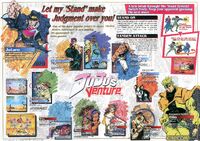
European arcade poster for the game
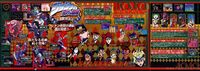
Japanese arcade affiche for the game
The Dreamcast version features an Alessi Fashion, which allows de-aged characters to be played in a prepare of rules (Both players fighting as the kid counterparts for the whole circular or the characters turning into children during a Stand Crash). This mode is unlocked by finishing Challenge mode with Alessi.
- Child forms (Jotaro, Kakyoin - both versions, the only difference being that Fearless Kakyoin holds a painting canvass as a kid - Avdol, Polnareff, Devo, Midler, Pet Store, Vanilla Ice, Alessi)
- Immature Joseph (Joseph)
- Teenage Joseph (Young Joseph)
- Iggy's older design (Iggy)
- Disguised Fat Woman (Rubber Soul)
- Boingo (Hol Equus caballus paired with Boingo; the de-aged Hol Equus caballus trades places with Boingo under his crate)
- Unnamed boy possessed by Anubis (Chaka, Anubis Polnareff)
- Unnamed cow possessed by Anubis (Khan)
- Unnamed male child with Hanged Man in his eyes (Hol Equus caballus paired with J. Geil)
- Unnamed old woman from Mariah'south fight (Mariah)
- Nukesaku (DIO)
- Wang Chan (Shadow DIO)
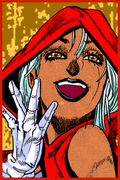
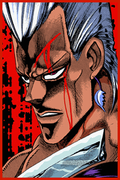
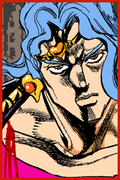
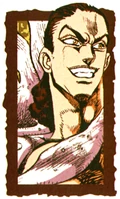
New Characters
| Characters from Heritage for the Future | ||||
|---|---|---|---|---|
| | | | | |
| Hol Horse | Pet Shop | Mariah | Anubis Polnareff | Vanilla Ice |
| | | | | |
| Rubber Soul | Khan | Hol Horse & Boingo | Fearless Kakyoin | |

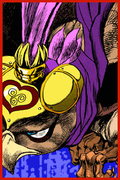


JoJo'south Bizarre Take chances Hard disk drive Ver.
JoJo's Baroque Adventure HD is a high-definition port of the game that was released for both PlayStation Network W and Xbox Alive W .
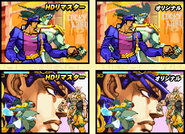
The game, apart from upscaled graphics, includes tweaked dialogue and fonts as well. Notably, it uses the super chinkle from the showtime JoJo's Venture, similar to the earlier Dreamcast port. Transparency has also been properly applied, replacing the sprite flashing in one case used. At that place are options to employ the original graphics style, however.
The HD re-release was delisted from Xbox Alive Arcade and PSN in September 2014.[1] It is assumed that this is a issue of Capcom no longer holding the license to create or distribute JoJo's Bizarre Adventure games, which was acquired by Bandai Namco Games.
Features
Story Mode
The HD update features the choice to play in either the classic arcade-manner or an "Arcade SD Manner," which has pixel-like art like the original games. Unlike the PlayStation port, this version of the game does not include the "Super Story Mode."[2]
Online Play
The game supports online play that includes the ability to filter opponents by location and connection speed, similar to the foyer systems seen in newer Capcom fighting games such as Super Street Fighter Four and Marvel vs. Capcom three.
The online mode introduces a new 8-thespian multiplayer mode where players can compete (while waiting to compete) for a chance to compete in the final showdown.
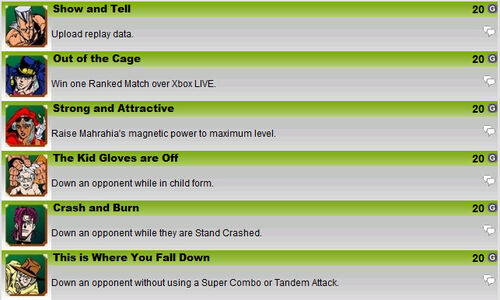
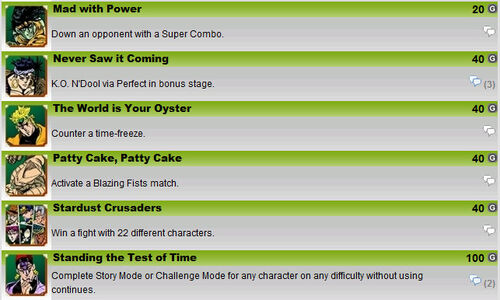
Achievements
Differences from the manga and anime
- Jotaro removes Kakyoin's flesh bud on the spot after defeating him as an antagonist. In the manga (as well as the anime adaptations), Jotaro takes him home and relieves him of DIO'due south slavery.
- Perhaps due to programming constraints, much of their graphic symbol story is not logically explained. I case is in Kakyoin's storyline, where after encountering Jotaro, his story shifts to Devo, fresh out of victimizing Polnareff, instead of introducing Polnareff in Hong Kong outset.
- Some grapheme interactions to scenes were cutting in the arcade version, possibly to brand the pacing advisable to a fighting game. Many of these were after introduced in the PlayStation port's Super Story Mode.
- Many grapheme-altering injuries were downplayed or outright cut, such as with Polnareff and Iggy.
- The playable villains in the story take some of their storyline and concepts fleshed out. Ane instance is Anubis, where the potential of betraying DIO is expounded. Most villains kickoff introduced in JoJo's Venture will almost always turn on DIO in their Story Mode.
- New scenarios were too written for Fearless Kakyoin, to explicate his lengthy hospital stay just for the game, in his instance, being haunted anew by Decease Thirteen while recuperating. Meanwhile, Young Joseph was given a new storyline in the HotF update, gaining a rivalry with Alessi. The rest of the cast, except for Mariah and Midler, were given storylines consequent to their source material.
- Midler is seen in a new grapheme design that has been the outcome of the collaboration of Araki and CAPCOM, at the latter's request. She has been drawn past Araki in this new design e'er since.
- All the same, in the Stardust Crusaders anime adaptation, her character design was reverted to the manga advent.
- Jotaro taunts N'Doul instead of talking to him after defeating the latter. This was properly represented afterward in the game's Super Story Mode.
- In the English language version of the game, the Super Story Style sequence of Cameo has Polnareff and Avdol but dropping pebbles and other debris on his breathing pipe. The Japanese version retains the two urinating into his animate pipe.
- Steely Dan's brutal punishment by Jotaro in Super Story Mode is remarkably shorter than in the manga. This is probably because of retentivity constraints in the PlayStation, where the mode is merely bachelor. In addition, much of the scenes depicting Jotaro's suffering from the hands of Steely Dan was cut.
- Enya is killed later on beingness defeated by Jotaro in Super Story Mode, whereas in the manga and anime, Steely Dan executes her.
- In the Japanese version, on N'Doul's bonus stage, he reacts to the dead helicopter pilot watch's alarm and cuts his hand. This was cut in the English version, merely tin exist enabled.[3]
- DIO's explosive death is more tearing here, where only his bloodied lower body is left. In the manga and anime, his upper torso remains, sans his decimated head.
- If the game is set to certain regions or the game's regulation is set to enabled or, in the Hard disk drive remake, expressions are disabled, DIO simply flies off-screen to his doom.[four]
- Perchance due to beingness untranslatable in a fighting game, Joseph's prank on Jotaro presently later on being revived was cutting every bit well. This scene is simplified in Jotaro's ending into Joseph being revived without the prank.
- While D'Arby's minigames are rigged on the outset play to lose all the time, when played in the gallery, information technology is possible to legitimately win in D'Arby'due south minigames. There are reports, nonetheless, of people winning legitimately on D'Arby's minigames on the first endeavor in Super Story Mode, without resorting to bluffing in his poker game.
Name Changes
Many of the names in the game's English localization have been changed due to copyright or other issues. The following are proper noun changes that are significant:
- Proud Lineage Joseph (誇り高き血統ジョセフ) was renamed equally JoJo.
- Evil Incarnate Dio!! (邪悪の化身ディオ!!) was renamed equally Shadow DIO.
- Anubis Two-Sword Style Polnareff (アヌビス二刀流ポルナレフ) was renamed equally Black Polnareff.
- Fear Transcended Kakyoin (恐怖をのり越えた花京院) was renamed equally New Kakyoin.
- J. Geil was renamed as J. Gale.
- Enya was renamed every bit Due north-Yah.
- Devo was renamed as D'Bo.
- Arabia Fats was renamed, oddly, as Alabia Fats.
- Vanilla Ice was renamed as Iced. However, the English language version still references the original namesake with his new win quote "You lot had a problem, I just solved it".
- Mariah was renamed every bit Mahrahia, an exaggeration of her original proper name.
- Kenny 1000 was renamed as Ken-East Gee.
- Rubber Soul was renamed as Robber Soul.
- Steely Dan was renamed as S-Terry Dan, a baloney of the original name.
- Oingo and Boingo were renamed as Oing and Voing.
- Some characters had only 1 letter changed, like Chaka to Chaca, Iggy to Iggi and Alessi to Alessy.
Gallery
Artwork
Sprites

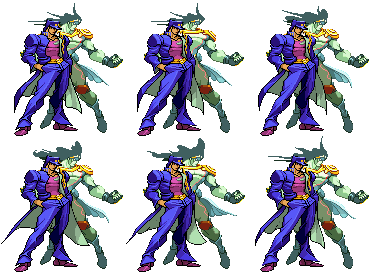
Jotaro Kujo
Star Platinum

Joseph Joestar

Hermit Royal

Jean Pierre Polnareff

Silver Chariot

Noriaki Kakyoin

Hierophant Greenish

Muhammad Avdol
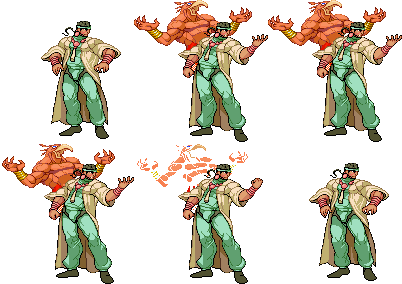
Magician's Red

Iggy
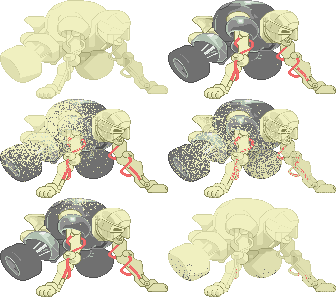
The Fool

Nukesaku the Idiot

DIO

The World

Vanilla Ice

Vanilla Ice (Cream)

Foam

Void

Hol Horse

Pet Shop

Horus

Mariah
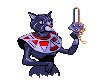
Bastet

Outlet (Bastet)

Alessi & Sethan

Devo the Cursed

Ebony Devil

Puppet

Rubber Soul

Yellow Temperance (Kakyoin)

Midler

High Priestess

Chaka

Khan

Black Polnareff

Anubis

JoJo

Fearless Kakyoin

Hierophant Light-green

Shadow DIO

The World

DIO

The Globe

Requiem
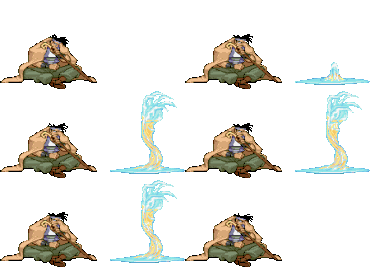
N'Doul & Geb

Vanilla Ice (Boss)
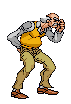
Gray Fly

Tower of Grey

Mannish Boy
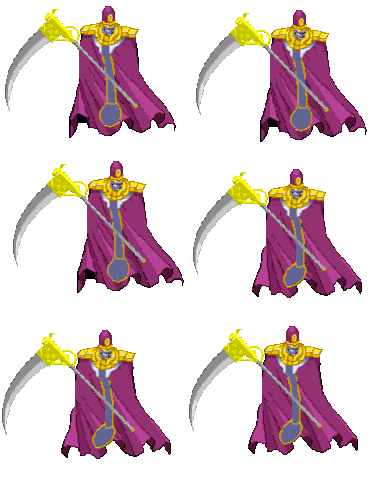
Death Thirteen
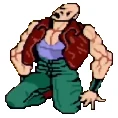
J. Geil

Hanged Homo

Boingo

Cameo

Judgement

Polnareff'south Sister (Golem)

Avdol (Golem)

Avdol's Spirit

Young Enya

Enya the Hag

Corpse 01

Corpse 02

Corpse 03

Corpse 04
Stages
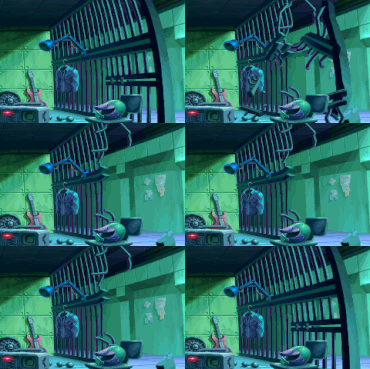
Jotaro's Stage
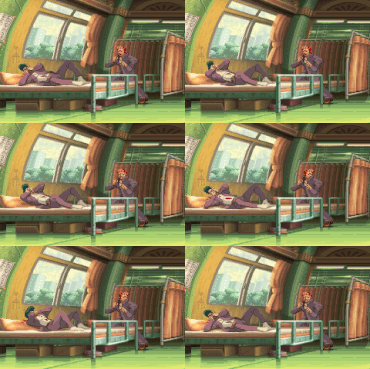
Kakyoin'due south Stage
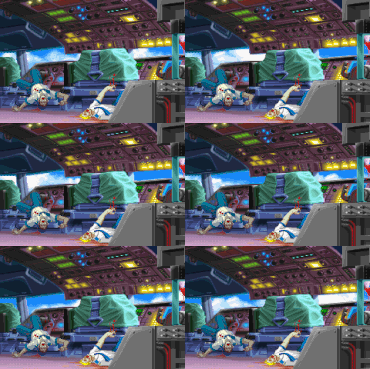
Greyness Fly'southward Stage
Polnareff's Stage
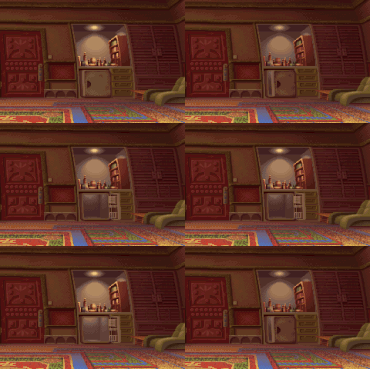
Devo's Stage
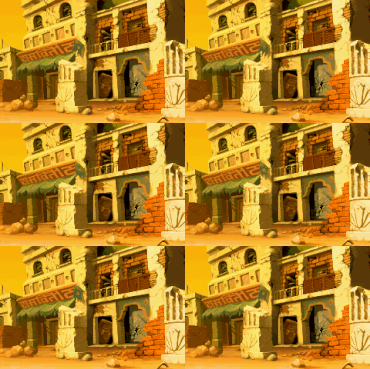
Hol Horse/Iggy'south Stage
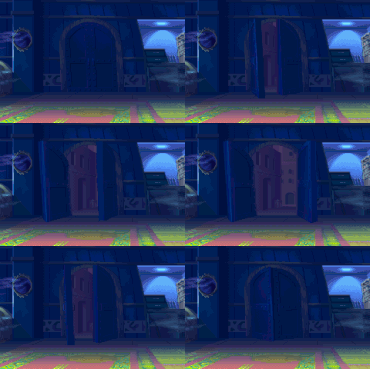
Enya's Stage
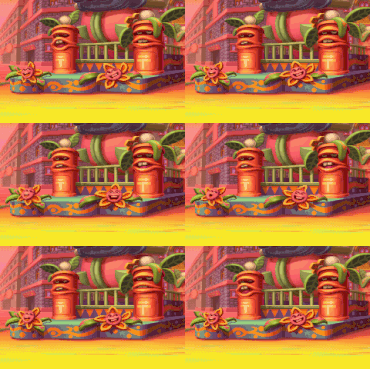
Death Thirteen's Stage

Midler/Avdol'due south Phase
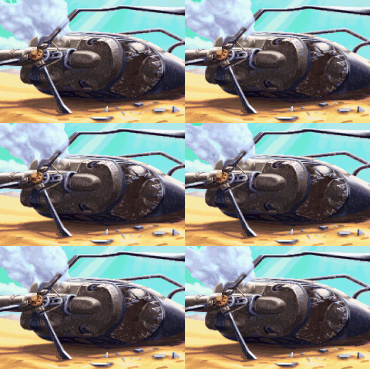
Due north'Doul's Stage
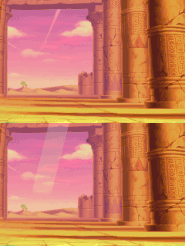
Anubis' Phase
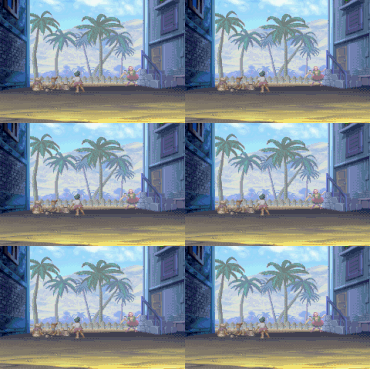
Joseph/Alessi's Stage
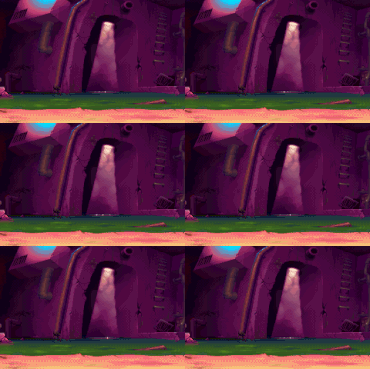
Pet Shop's Phase
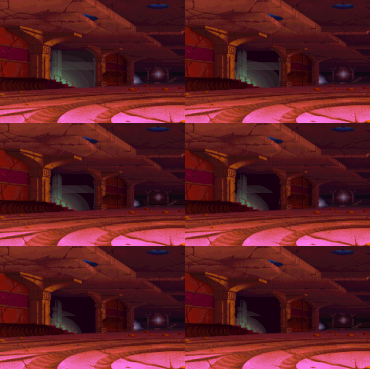
Vanilla Ice's Stage
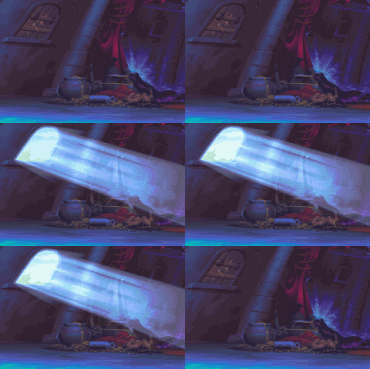
Shadow DIO's Stage
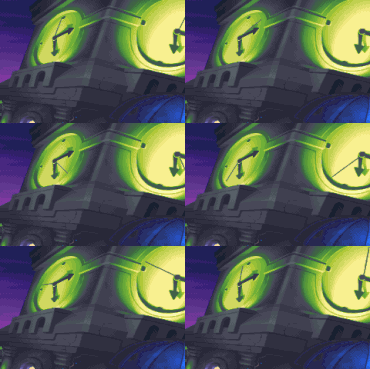
Fearless Kakyoin's Stage
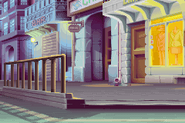
DIO'southward Stage
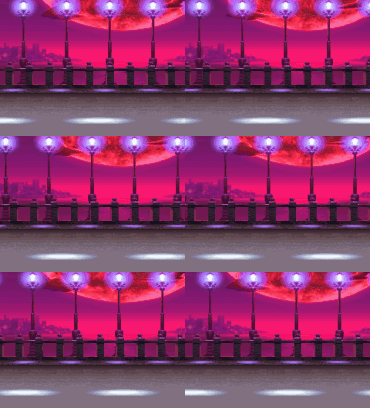
Final Stage
Hd screens
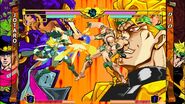
DIO and Jotaro performing a Blazing Fists Match
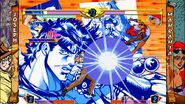
Onetime Joseph's Special showing flashbacks of his youth from Part 2
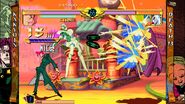
Kakyoin and Hierophant Green
Videos

Jojo's Bizarre Adventure Hd Ver. - Game Intro -PS3- ***HI-QUALITY***

CM カプコン ジョジョの奇妙な冒険 (PS) JOJO'S BIZARRE ADVENTURE

JoJo'due south Baroque Adventure Hard disk drive

Xbox 360『ジョジョの奇妙な冒険 未来への遺産HD Ver.』PV2

ジョジョの奇妙な冒険 未来への遺産HD Ver.
Pro FG players Tokido and Daigo Umehara testing the game + impressions.
Trivia
- Heritage for the Hereafter marks the beginning time that a JoJo-based game has seen an English release, albeit with changed names to avert possible legal issues.
- The game'south English version logo seems to have become the de facto English logo of the unabridged franchise, as even All Star Battle has adapted the overall look of the English language logo, which was first seen in this game. However, as of Optics of Heaven, all English logos of the series now follow the i introduced past Crunchyroll, which, however, has some touches of the aformentioned English logo.
- The game pays homage or picks up inspirations from other JoJo-related media that came earlier it:
- 1 of Avdol's alternate color schemes turns his glaze red and shirt to yellow, similar his appearance from the 1993's and 2001'southward OVA. The same goes for Joseph Joestar, Polnareff, and Black Polnareff, both of them having alternate colour schemes that resemble their OVA appearance.
- Hacking the game reveals an unused variation of DIO'south mansion stage, where a window is wide open, sunlight flowing into DIO's coffin. This is a canon issue referenced in the manga, mirrored by the Anime and OVA.
- One of Iggy's special moves make him create a giant wave of sand in the opponent'south management, similar to how he attacked Vanilla Water ice in the OVA
- As well, later JoJo games pay homages or made references to this game:
- The underlying mechanics of All Star Battle, and by extension, Eyes of Sky largely borrows a lot from this game.
- In All Star Boxing, Part 1 Dio's Infinite Ripper Stingy Eyes HHA uses the exact aforementioned animation (Including Dio rearing backward) as DIO's version of said movement in this game, and DIO's HHA motility in ASB is very similar to Shadow DIO's "Checkmate!" super.
- All Star Boxing has two alternate gratuitous-DLC costumes for Jotaro and Polnareff, based on promotional material for the game.[v]
- Vento Aureo for the PS2 (also by Capcom) features an orchestrated rendition of Polnareff'south theme from this game.
- in Jump Ultimate Stars, Dio'southward win and lose animations are the same win animations from High Dio's win animations in HFTF. Ane of dio's upwardly special summons the Road Roller in the same style and sequence as in heritage. Dio's Showtime push button move has him reading a volume and teleporting backside opponents like to Shadow Dio. Ane of Jotaro's win pose is the exact aforementioned as in Heritage as well.
- Too being based on Part 3 (Stardust Crusaders), this is the kickoff game to have elements from more than one JoJo saga.
- Part ane: Wang Chan as Shadow DIO's "child" form during Alessi's Stand ability, a shot of the Stone Mask appears when a character is stand crashed and both versions of Dio have Space Ripper Stingy Eyes as a special motion.
- Part 2: Young Joseph is a playable character, Caesar appears in the Immature Joseph's special move that contains several manga console flashbacks besides as Lisa Lisa doing the aforementioned for Old Joseph's version, the Red Stone of Aja is used as one of Young Joseph's supers and the crossbow he used against Wamuu, as well as the coke canteen during his introduction scene, appears in his moveset.
- Part 4: The arrow appears during Polnareff "Requiem" super, one of Jotaro's alternating color scheme recolors his glaze, lid and pants white, much like his Part 4 outfit and in 1 of DIO'due south alternating color schemes, The World is pinkish and blue giving information technology an appearance similar to Crazy Diamond.
- Part 5: Chariot Requiem appears as a super combo for Polnareff and one of his win quotes translates to "We'll run across again in the future...in Italy" and the icon for Italian republic in the story style is Giorno Giovanna's ladybug brooch.
- Four of the game'south seiyuu, Mitsuaki Madono (Kakyoin), Hōchū Ōtsuka (Joseph), Sho Hayami (Vanilla Water ice), and Wataru Takagi (Cameo) return to voice unlike characters in All Star Battle (Madono voices Role 8's Josuke, Hōchu voices Hol Horse, Hayami voices Enrico Pucci, and Takagi voices Okuyasu Nijimura).
- Hayami reprised his role every bit Vanilla Ice in the Stardust Crusaders anime, which carried over to Eyes of Heaven. As a result, Pucci is voiced by a new Seiyuu.
- The Hard disk version is the starting time console release of the game overseas in which the player can decensor the game, via the "Expressions" selection. Setting information technology to "Original" restores ruby blood graphics likewise every bit DIO's Story Mode defeat animation of him exploding violently.
- For its PlayStation release, the game has sketchy censorship fifty-fifty in its Japanese version. Information technology did not retain much of the fierce animations in Arcade Way, such as DIO'southward explosive decease.
- While some of its sound effects take been borrowed from the Darkstalkers series, the unique sound furnishings used in this game have been recycled several times in other titles from Capcom. It has been reused in Capcom vs. SNK 2, Capcom Fighting Evolution, Marvel Vs. Capcom 2, and even in the Street Fighter IV series.
- Some of the visual effects used in the game, particularly the sparks, dust, and super sparks have been borrowed from Capcom's Marvel VS series.
- Despite Alessi'due south name being changed in the international release, Young Joseph's opening however has the original name. This was fixed in the console and HD versions of the game.
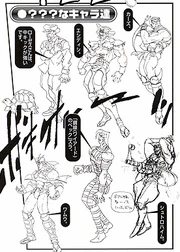
Concept fine art of unused characters
- If the histrion is using either DIO, Jotaro, or Shadow DIO and they are caught in stopped time, they can input the fourth dimension stop command and enter or even effectively steal the stopped time.[6] This tactic was previously unknown in mainstream gameplay until made pop by the HD re-release, as an accomplishment. This tactic is also the final Secret Factor in the game, non counting the interlude chapters.
- The characters introduced in the Heritage for the Future update have no A.I. (Bogus Intelligence) at all. It wasn't until the PlayStation port that Capcom gave those grapheme A.I for the Super Story Fashion.
- There is a glitch where if someone loses a round, the thespian tin perform a time stop with DIO or Jotaro and the opponent will exist frozen between rounds. If the opponent is hit during the freeze, they automatically lose the circular.[seven]
- In the game's Secret File, there is concept artwork of Roses, as well as Kars, Wamuu, Esidisi, Wired Beck, and Stroheim from Battle Trend, indicating that they were originally fix to announced in the game during evolution.
- Heritage for The Future has had every unmarried character in its game exist remade in the fighting engine MUGEN, software that lets people create and lawmaking their own characters using 2D sprites. All characters (including clone characters similar Fearless Kakyoin) accept been remade into this engine using the unique stand and downwards mechanic. This has as well been the inspiration for other fan-created MUGEN characters such equally Caesar Anthonio Zeppeli And Josuke Higashikata
- JoJo'south Bizarre Adventure: Heritage for the Future past Capcom (Japanese)
- JoJo's Bizarre Adventure HD Ver. Official website (Japanese)
- ↑ JoJo's Bizarre Run a risk Hard disk has been removed from Xbox Alive and Eu PSN
- ↑ http://world wide web.capcom-unity.com/dubindoh/blog/2012/08/xv/jojos-bizarre-adventure-overview-part-i-what-is-jojos-bizarre-adventure
- ↑ https://www.youtube.com/picket?v=HhQYIeEBs9s
- ↑ https://www.youtube.com/lookout man?5=Xnucu3Tl_Hw
- ↑ http://shoryuken.com/2013/12/23/classic-jojos-baroque-adventure-arcade-artwork-inspires-complimentary-downloadable-costumes-for-all-star-battle/
- ↑ https://www.youtube.com/lookout?5=HPaApYzh-pU
- ↑ https://www.youtube.com/watch?v=oVJr5_e9hLc
| Stardust Crusaders | |||||||
|---|---|---|---|---|---|---|---|
| |||||||
| |||||||
| |||||||
| |||||||
| |||||||
|
| Games | |
|---|---|
| JoJo video games |
|
| Spring video games |
|
| Other games |
|
Post a Comment for "Jojo No Kimyou Na Bouken Snes Game Box Art"